The Necessary and Proper Clause: Key Interpretation Debates
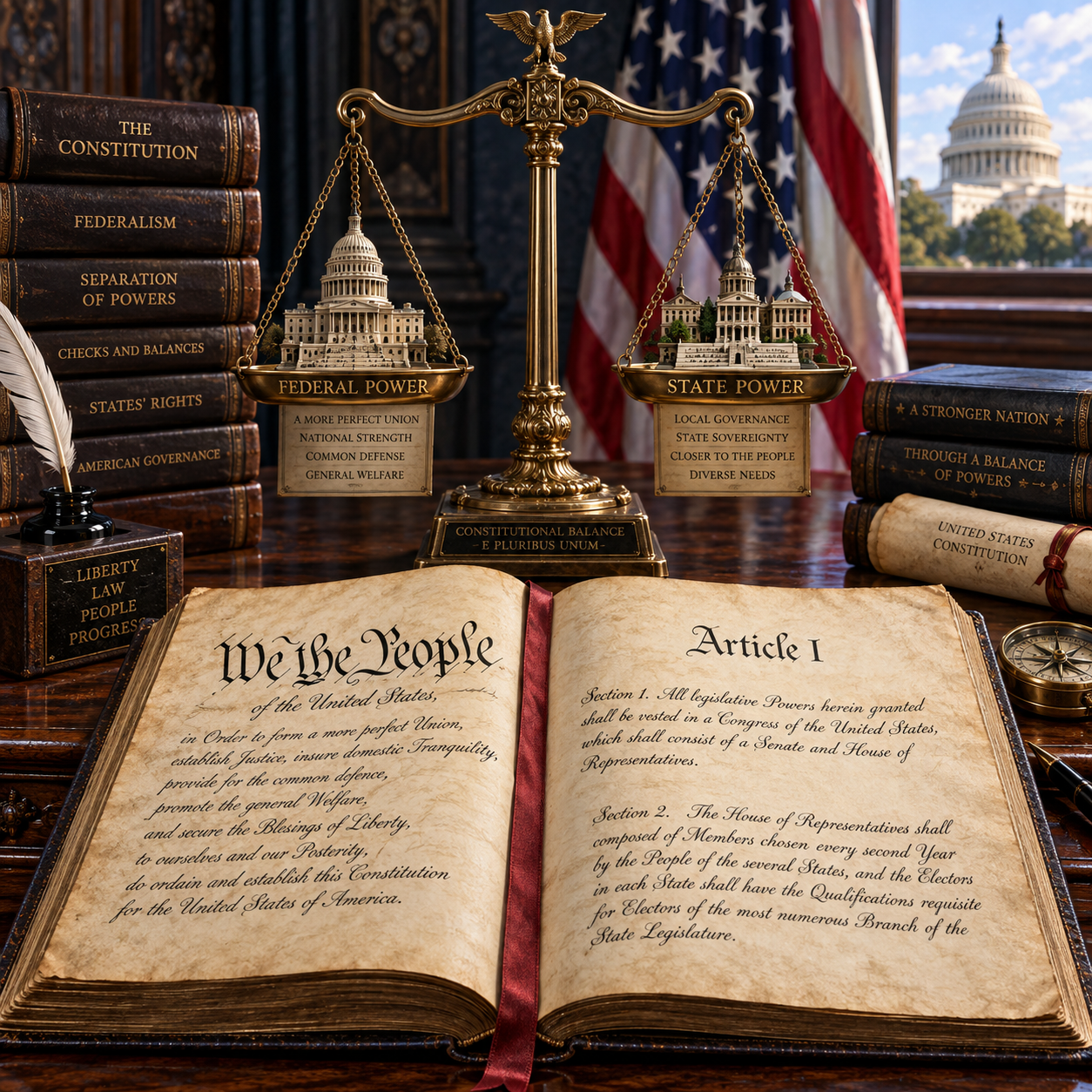
The Necessary and Proper Clause helps Congress carry out the powers the Constitution gives it. Its meaning has long been debated: How much freedom does Congress have to choose the means for exercising those powers, and where should courts draw the line?
Understanding the debate requires looking at the clause alongside Congress’s enumerated powers, the concept of implied powers, federalism, and landmark decisions such as McCulloch v. Maryland. The clause matters because it links the Constitution’s specific grants of authority to the practical tools government may use.
What the Necessary and Proper Clause Says
The Necessary and Proper Clause is in Article I, Section 8 of the Constitution. It authorizes Congress to make laws needed to carry out its listed powers and other powers vested in the federal government.
The clause appears at the end of Article I, Section 8, which lists powers such as taxing, borrowing money, regulating interstate commerce, establishing post offices, and raising and supporting armed forces. It says Congress may make laws that are “necessary and proper” for carrying those powers into execution. The full text is available through the Constitution Annotated, a resource maintained by the Library of Congress.
That placement is important. The clause is commonly called an incidental powers clause because it concerns the means Congress may use to implement other constitutional powers. It does not list a free-standing subject, such as education or health, over which Congress may legislate without reference to another source of authority.
The phrase “necessary and proper” also invites interpretation. Does “necessary” mean indispensable, or does it include useful and appropriate means? And how closely must a law connect to a power expressly listed in the Constitution? Those questions frame the central debate.
Enumerated Powers and Implied Powers
Enumerated powers are the authorities expressly listed in the Constitution; implied powers are means Congress may use to exercise those authorities. The Necessary and Proper Clause connects the two.
For example, the Constitution gives Congress power to tax and spend, but it does not spell out every administrative step needed to collect taxes or manage federal funds. Congress may establish offices, set procedures, and create rules that help carry out those responsibilities. Such measures can rely on implied powers when they serve a valid enumerated power.
A practical way to analyze a law is to ask three questions:
- Identify the constitutional end: Which enumerated power is Congress trying to exercise?
- Assess the means: Does the law help carry out that power in a reasonable, appropriate way?
- Check the boundary: Does the law violate another constitutional rule or claim authority unrelated to the identified power?
This framework keeps the clause connected to the rest of Article I. A law does not become constitutional merely because Congress considers it helpful. Its defenders must identify a constitutional power the law serves, and the means must remain within constitutional limits.
The Debate Over “Necessary and Proper”
The main interpretive debate is whether “necessary” requires a close, indispensable connection or permits Congress to choose among reasonable means. Narrow readings place tighter limits on implied powers; broader readings give Congress more discretion while keeping it tied to constitutional ends.
Narrow interpretations
A narrow approach often treats “necessary” as meaning essential or very closely connected to carrying out an enumerated power. From this perspective, the clause should not allow Congress to expand its authority simply by labeling a policy useful. Narrow readings emphasize the Constitution’s structure: Congress has specified powers, and the states retain authority outside the federal government’s assigned sphere.
Supporters of this view may also stress that broad implied powers can make the list of enumerated powers less meaningful. If nearly any federal policy can be linked to a distant constitutional objective, they argue, the limits of the federal government become difficult to identify.
Broader interpretations
A broader approach reads “necessary” as appropriate or conducive, rather than strictly indispensable. Congress can select practical means to carry out its constitutional responsibilities, even when other methods might also work. This reading recognizes that a written Constitution cannot name every office, procedure, or tool required to govern over time.
The approaches are not simply a choice between unlimited federal authority and no implied powers. Both can accept that Congress has implied powers while disagreeing about how strong the connection to an enumerated power must be. Courts may consider the law’s purpose, its fit with a granted power, and other constitutional limits. The disagreement is about the standard and its application, not whether the clause erases the rest of the Constitution.
McCulloch v. Maryland and the Clause’s Reach
McCulloch v. Maryland (1819) is a landmark case because the Supreme Court upheld Congress’s authority to establish a national bank as a means of carrying out its constitutional powers. The Court also rejected Maryland’s attempt to tax the bank, reinforcing federal supremacy in a valid exercise of federal authority.
Congress’s enumerated powers did not expressly include chartering a bank. The Court reasoned that a bank could help Congress carry out powers such as taxing, borrowing, and regulating commerce. Chief Justice John Marshall’s opinion adopted a broad understanding of the Necessary and Proper Clause: Congress could choose appropriate means to pursue legitimate constitutional ends, provided those means were not prohibited and were consistent with the Constitution’s text and structure.
The decision is often associated with the principle that the federal government has implied powers, but it did not declare those powers unlimited. The national bank had to be connected to powers the Constitution actually granted. The case also addressed the Supremacy Clause: a state could not use taxation to obstruct a valid federal instrument. That protection applies when federal action is constitutionally authorized; the Supremacy Clause does not make every federal law valid simply because Congress enacted it.
Federalism and Limits on Congressional Power
The Necessary and Proper Clause affects federalism because its interpretation influences how far federal law can reach into matters also governed by states. A broader reading can support effective national action, while a narrower reading places greater emphasis on preserving state authority.
Federalism divides governmental responsibilities between the national government and the states. Since many modern problems cross state lines, Congress may need flexible tools to carry out powers such as regulating interstate commerce or raising revenue. Yet flexibility can shift practical authority toward the federal government, especially when Congress connects a law to a broadly stated constitutional objective.
To evaluate a claim of congressional authority, keep the steps distinct:
- Find the enumerated power Congress relies on.
- Examine whether the law’s means reasonably serve that power.
- Consider other constitutional constraints and the role left to the states.
This approach avoids two common errors: treating the clause as an independent grant of unlimited power, or assuming that Congress may use only means named word for word in the Constitution. The real constitutional question is how close and reasonable the connection must be, given the law and the power invoked.
Why the Interpretation Debate Matters
The interpretation debate matters because it shapes how Congress responds to national needs and how courts enforce constitutional boundaries. The same reading can affect the reach of federal legislation, the authority of states, and the balance established by the Constitution.
When a dispute arises, the key issue is often not whether Congress may act in the abstract, but whether a particular law is a valid means of exercising a particular power. The Necessary and Proper Clause provides room for practical government, while the enumerated powers and other constitutional provisions define the framework within which that room exists.
That is why McCulloch v. Maryland remains central to constitutional education: it explains how implied powers can arise from the Constitution without turning them into unlimited authority. Readers can follow the debate by asking what power supports a law, how the law advances that power, and what constitutional limits remain in force.
Frequently asked questions
What does the Necessary and Proper Clause mean? It allows Congress to make laws that are appropriate for carrying out powers granted by the Constitution to Congress and the federal government.
Does the clause give Congress unlimited power? No. Congress must connect a law to an enumerated or otherwise constitutionally vested power, and the law must comply with other constitutional limits.
How does it relate to enumerated powers? Enumerated powers identify federal responsibilities; the clause allows Congress to use implied means to carry them out.
Why is McCulloch v. Maryland important? The 1819 decision upheld Congress’s authority to establish a national bank under implied powers and held that Maryland could not obstruct the valid federal institution through taxation.