The Commerce Clause: Evolution and Impact on Federal Power
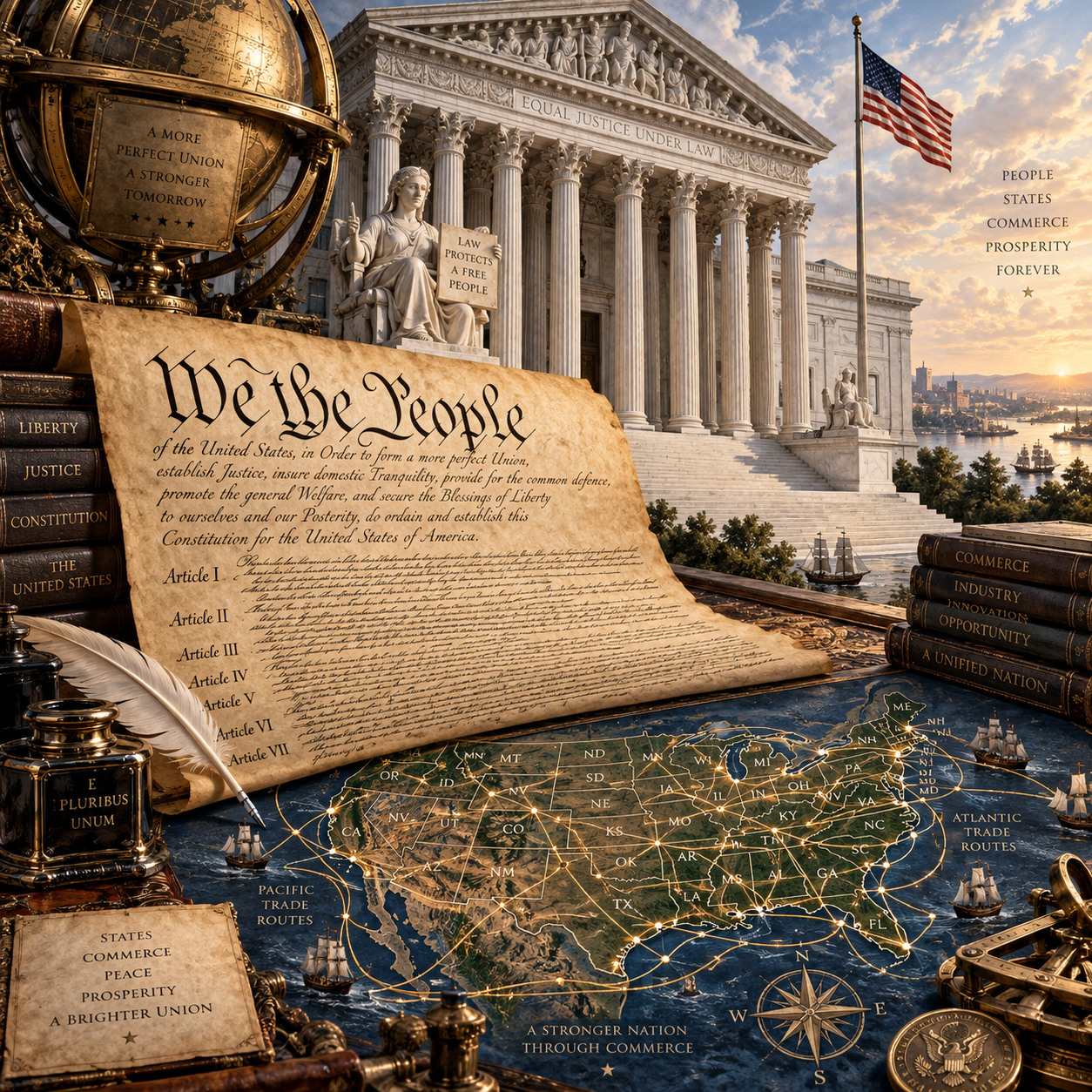
The Commerce Clause is one of the most important sources of congressional power in the U.S. Constitution. Its interpretation has helped determine when the federal government may regulate economic activity and when authority remains with the states.
What Is the Commerce Clause?
The Commerce Clause is Article I, Section 8, Clause 3 of the U.S. Constitution, which authorizes Congress to regulate commerce with foreign nations, among the several states, and with Native tribes. It provides a constitutional foundation for national rules involving interstate commerce, while also operating within the larger structure of federalism.
The clause states that Congress may “regulate Commerce with foreign Nations, and among the several States, and with the Indian Tribes.” In the eighteenth century, commerce generally referred to trade and commercial exchange, including transportation and navigation. The framers included the provision partly because the Articles of Confederation had left the national government too weak to address trade disputes among states.
The Commerce Clause does not give Congress unlimited authority over every matter that affects the economy. Courts have had to distinguish between activity connected to interstate markets and activity that is purely local. The Necessary and Proper Clause may support legislation that helps Congress carry out its enumerated powers, but it does not erase the Constitution’s division of authority.
Congressional power under the clause commonly covers three categories: the channels of interstate commerce, such as highways and waterways; the instrumentalities of commerce, such as vehicles and communication systems; and activities that substantially affect interstate commerce.
Early Interpretations and the Rise of Federal Authority
Early interpretations of the Commerce Clause treated commerce as more than the simple buying and selling of goods, but they also recognized boundaries between national and state power. The Supreme Court’s early decisions established that interstate trade and navigation could require national oversight when state rules interfered with a unified market.
The foundational case was Gibbons v. Ogden in 1824. New York had granted an exclusive steamboat monopoly, while a competing operator relied on a federal license. Chief Justice John Marshall’s opinion held that Congress’s power over interstate commerce included navigation and that federal law prevailed when it conflicted with state restrictions.
Gibbons strengthened federal authority, but its reasoning was not a declaration that Congress could regulate every local activity. The decision recognized that commerce “among” the states involved interactions crossing state boundaries. States retained substantial authority over internal matters, including many health, safety, and business regulations.
This period also established an important constitutional principle: when federal and state laws conflict within an area of valid federal authority, federal law generally controls under the Supremacy Clause. The Commerce Clause therefore shaped both economic regulation and the practical relationship between national and state governments.
The Commerce Clause During the New Deal Era
During the New Deal era, the Supreme Court accepted a broader understanding of congressional power, especially when local conduct had a substantial economic effect on interstate commerce. This shift enabled Congress to address nationwide economic problems through federal legislation.
The Great Depression exposed the limits of relying only on state-by-state regulation. Markets crossed state lines, yet businesses and workers often faced different rules in each jurisdiction. New Deal programs sought to regulate wages, production, labor relations, agriculture, and other economic conditions at a national level.
The decisive reasoning appeared in Wickard v. Filburn in 1942. Roscoe Filburn, an Ohio farmer, grew more wheat than federal law allowed. He argued that the excess wheat was for use on his own farm and never entered interstate commerce. The Supreme Court upheld the regulation because many similar local choices, considered together, could reduce demand in the national wheat market.
Wickard introduced a powerful aggregation principle. An individual act may be too small to affect interstate commerce by itself, yet Congress may regulate it when the combined effect of similar conduct could influence a national market. This interpretation greatly expanded federal authority, although it also raised concerns about whether nearly any economic activity could be connected to interstate commerce.
Landmark Supreme Court Cases
Landmark Commerce Clause cases show a movement from broad national authority toward a modern effort to identify enforceable limits. Together, they explain how the Supreme Court has defined commerce, economic effects, and the boundary between federal and local regulation.
Gibbons v. Ogden
Gibbons v. Ogden established that interstate commerce includes navigation and that Congress may regulate activity crossing state lines. Its broader significance was structural: the decision rejected a narrow reading that would have confined federal power to the final sale of goods.
Wickard v. Filburn
Wickard v. Filburn upheld federal limits on wheat production even though the farmer’s wheat was intended for personal use. The Court reasoned that personal production, when aggregated across many farmers, could affect interstate supply and prices. The case became the leading example of how indirect economic effects can support federal regulation.
United States v. Lopez
United States v. Lopez in 1995 marked an important limit. The Court struck down the federal Gun-Free School Zones Act because possessing a gun near a school was not, in the statute’s design, an economic activity substantially related to interstate commerce.
The decision did not eliminate broad congressional power. Instead, it emphasized that the federal government must identify a meaningful connection to commerce rather than rely on a chain of assumptions. Lopez reaffirmed that the Constitution preserves areas of state authority.
Gonzales v. Raich
In Gonzales v. Raich in 2005, the Court upheld federal regulation of locally grown medical marijuana permitted under California law. The majority applied the logic of Wickard: local cultivation could be part of a broader market that Congress was attempting to regulate comprehensively.
The contrast between Lopez and Raich is instructive. Economic activity that forms part of a national market may fall within federal authority, while noneconomic conduct requires a more convincing connection to interstate commerce.

The Commerce Clause and Federalism
The Commerce Clause affects federalism by giving Congress national regulatory power while preserving a constitutional role for the states. The central question is whether a federal law addresses interstate commerce or reaches too far into matters traditionally controlled by state governments.
Federal regulation often makes practical sense when economic activity crosses state boundaries. National standards can prevent companies from avoiding regulation by moving operations, and they can create consistent rules for transportation, labor, environmental protection, and consumer markets.
State autonomy remains significant, however. Under the Tenth Amendment and the Constitution’s structure, the federal government possesses only powers granted to it. The Commerce Clause cannot automatically convert every local concern into a federal matter.
Federalism creates a recurring trade-off:
- National regulation can solve problems that no single state can manage effectively.
- State authority allows policies to reflect local conditions and protects experimentation in governance.
- Judicial review supplies a check when Congress regulates activity without a sufficient connection to interstate commerce.
Courts may also evaluate whether Congress is regulating private conduct directly or attempting to command states to administer a federal program. That distinction shows that Commerce Clause disputes involve federalism as well as economic policy.
Modern Impact and Continuing Debate
Today, the Commerce Clause remains central to federal legislation involving national markets, transportation, workplace rules, agriculture, civil rights, health care, and controlled substances. Its modern impact comes from the combination of broad precedent and constitutional limits.
Congress may regulate economic activity that crosses state lines or substantially affects interstate markets. Under the Necessary and Proper Clause, it may also adopt supporting rules that are useful to a broader regulatory scheme. Yet the reasoning in United States v. Lopez warns that a statute cannot rest solely on a remote or speculative connection to commerce.
Debates over federal power often involve competing values rather than a single mechanical test. Supporters of broad authority emphasize national markets and collective-action problems. Critics emphasize individual liberty, state sovereignty, and the danger of allowing economic language to become a justification for unlimited government power.
The individual mandate litigation under the Affordable Care Act illustrated this tension. In National Federation of Independent Business v. Sebelius, the Supreme Court concluded that the Commerce Clause did not authorize Congress to compel people to enter commerce by purchasing health insurance, although the payment could be sustained under Congress’s taxing power. The decision demonstrated that the clause can limit federal action even when a law concerns a national economic system.
The continuing debate is therefore about line-drawing: when does regulation of an existing market become an attempt to create economic activity, and when does a local practice become part of a national market? The answers depend on statutory design, factual findings, precedent, and the constitutional structure.
Why the Commerce Clause Matters
The Commerce Clause matters because it has shaped the practical scope of the federal government and the continuing balance between national authority and state sovereignty. It is a central tool for understanding how the U.S. Constitution responds to an interconnected economy.
Its history follows a recognizable pattern. Gibbons v. Ogden supported national control over interstate navigation and trade. The New Deal era and Wickard v. Filburn accepted broader regulation of activities with aggregate economic effects. Later decisions such as Lopez and Raich clarified that the power remains broad but is not without boundaries.
For students of constitutional law, the clause provides a useful framework for studying enumerated powers, federalism, judicial review, and the Necessary and Proper Clause together. For citizens, it explains why Congress can regulate some nationwide economic problems while states retain authority over many local issues.
Understanding the Commerce Clause requires attention to both sides of the constitutional equation: effective national governance and meaningful limits on federal power. That tension has guided Supreme Court doctrine for more than two centuries and will continue to shape constitutional debates.
Frequently Asked Questions
What does the Commerce Clause say?
The Commerce Clause appears in Article I, Section 8, Clause 3 of the U.S. Constitution. It gives Congress power to regulate commerce with foreign nations, among the states, and with Native tribes.
Why was the Commerce Clause included in the Constitution?
It was included to give the national government authority over interstate trade and to reduce conflicts caused by inconsistent state commercial policies under the Articles of Confederation.
How did Wickard v. Filburn expand federal power?
Wickard held that Congress could regulate local wheat production because many similar acts, taken together, could substantially affect the interstate wheat market.
What limits did United States v. Lopez place on Congress?
Lopez held that Congress could not justify every federal law through a remote connection to interstate commerce. The regulated conduct must have a meaningful relationship to economic activity or interstate commerce.
How does the Commerce Clause affect federalism?
It gives Congress authority to address national economic problems while leaving states significant control over local matters. Supreme Court decisions help define the boundary between those levels of government.