The 14th Amendment: Equal Protection and Due Process Explained
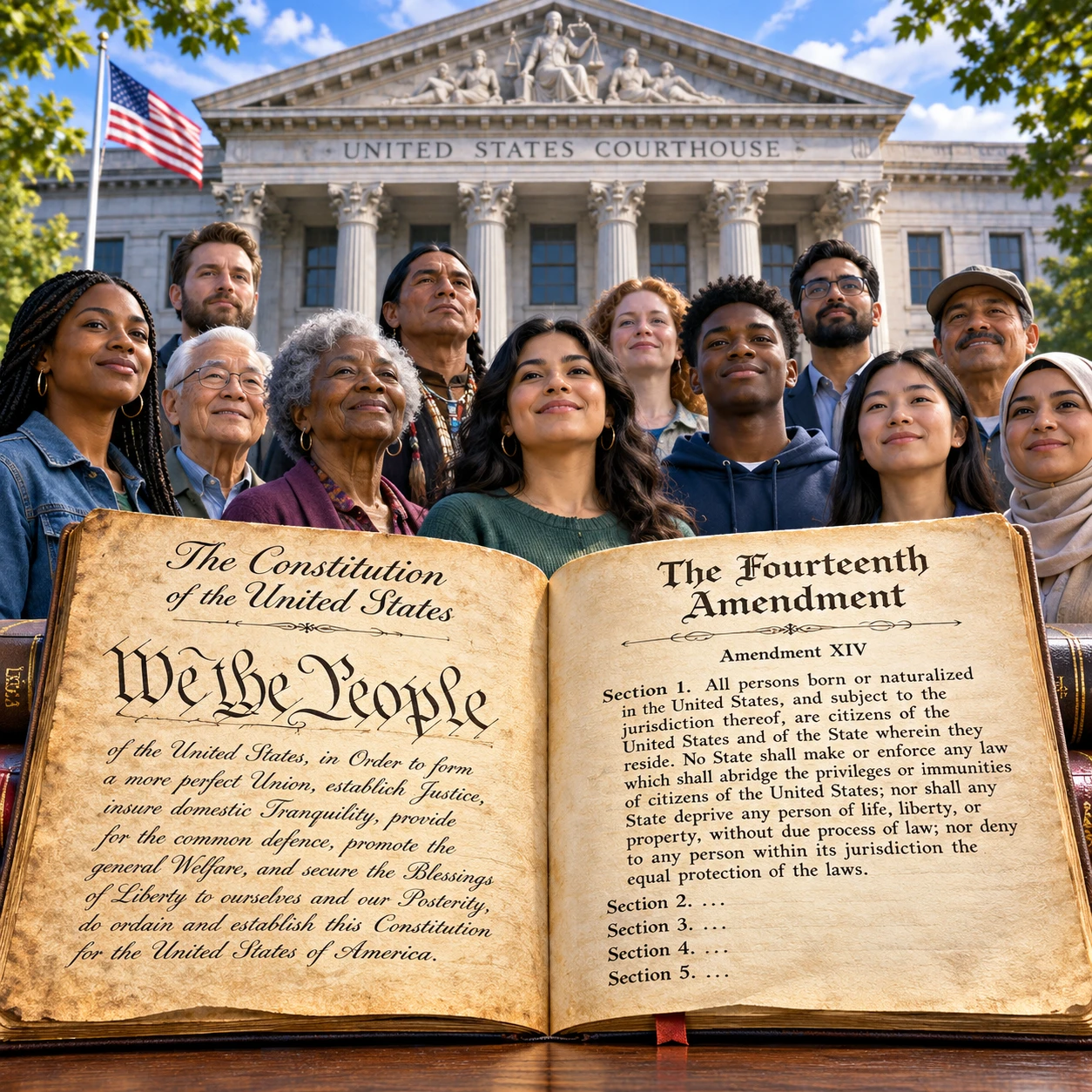
The Fourteenth Amendment is a cornerstone of constitutional rights in the United States. Its Equal Protection and Due Process Clauses limit state governments, shape how courts review laws, and help define the relationship between people and government.
The clauses are related, but they do different work. Equal protection asks whether government treats people differently in a constitutionally acceptable way. Due process asks whether government is respecting protected rights and following fair procedures. The answers depend on the facts, the right involved, and how courts interpret the Constitution.
What the Fourteenth Amendment Says
The Fourteenth Amendment defines national citizenship and places important limits on state governments. Ratified in 1868 after the Civil War, it contains a Citizenship Clause, a Due Process Clause, and an Equal Protection Clause, among other provisions.
The Citizenship Clause establishes that people born or naturalized in the United States, and subject to its jurisdiction, are citizens of the United States and of the state where they reside. The amendment then says that no state may deprive a person of life, liberty, or property without due process of law, or deny any person within its jurisdiction the equal protection of the laws.
Those words—especially “any person”—matter. The protections are not limited to U.S. citizens. Their application still depends on the legal issue and the circumstances, but the text reaches people within a state’s jurisdiction.
The amendment was adopted in the Reconstruction era, when the nation sought to establish citizenship and protect rights after slavery. Its meaning has developed through constitutional interpretation and court decisions. For the text and historical context, see the Constitution Annotated from Congress.gov.
Equal Protection: What It Requires
The Equal Protection Clause requires state governments to treat people alike when they are similarly situated, unless a legally sufficient reason justifies different treatment. It does not forbid every distinction; it requires courts to assess the classification and the government’s reason for using it.
A law may draw a line based on age, residency, occupation, or another characteristic. Courts generally ask what group the law distinguishes, what governmental interest it serves, and how closely the classification fits that interest. The level of judicial scrutiny varies with the classification and the rights affected.
For many ordinary economic or social classifications, courts use rational-basis review: the law must have a rational connection to a legitimate government interest. Certain classifications, including those involving race, receive more demanding review. Some classifications based on sex receive intermediate scrutiny. These standards are broad summaries; the precise test and its application depend on precedent and context.
For example, a state rule that gives a benefit to residents but not nonresidents raises an equal protection question: what distinction is being made, and is it constitutionally justified? The clause does not automatically require identical outcomes. It requires a legally adequate justification for certain forms of unequal treatment.
Due Process: What It Protects
The Due Process Clause protects people from state action that deprives them of life, liberty, or property without constitutionally adequate process. Courts also interpret due process to protect some fundamental liberties from certain government restrictions.
Procedural due process concerns the fairness of the process used before government takes a protected interest. Depending on the situation, that may require notice of the proposed action and a meaningful opportunity to respond. A person facing loss of a license, for instance, may be entitled to a hearing, though the required procedures depend on the interests and circumstances involved.
Substantive due process concerns whether government may restrict certain fundamental rights at all, even if it follows fair procedures. Courts have used this doctrine in cases involving protected liberties. Which rights qualify, how they are defined, and what standard applies can be contested and can change through judicial decisions.
“Liberty” and “property” have legal meanings broader than physical freedom and owned objects. A government benefit or license, for example, may count as a protected property interest when law gives a person a legitimate claim to it. Due process does not guarantee a favorable result; it sets constitutional limits on how government may act.
How the Two Clauses Differ—and Overlap
The main difference is the question each clause asks: equal protection examines unequal treatment, while due process examines government deprivation of protected interests and the fairness or permissibility of that deprivation.
Consider a state that suspends a professional license. A due process claim might ask whether the license holder received adequate notice and a chance to challenge the suspension. An equal protection claim might ask whether the state applied the suspension rule differently to comparable license holders without a sufficient justification.
The same government action can raise both questions. A law that restricts a liberty for one group but not another may prompt a due process inquiry into the liberty itself and an equal protection inquiry into the classification. The clauses are distinct, but courts sometimes analyze them together because the facts connect the issues.
A useful way to keep them straight is to ask two questions in order: What interest or group is affected? Then ask whether the complaint concerns unfair procedure or unequal treatment. That framing helps identify the relevant clause without assuming the outcome.
How the Amendment Applies to State Governments
The Fourteenth Amendment directly limits state governments and their officials, including state and local actors exercising government authority. It does not generally regulate purely private conduct by individuals or businesses.
This state-action principle means that a private employer’s decision, for example, is not automatically a Fourteenth Amendment violation. Other sources of law—such as federal or state statutes, contracts, or state constitutional provisions—may still apply. When a private party acts jointly with government or performs a function legally attributable to the state, the analysis can become more complex.
The amendment also connects many protections in the Bill of Rights to the states through the incorporation doctrine. The Bill of Rights originally restricted the federal government. Through case-by-case decisions under the Fourteenth Amendment’s Due Process Clause, the Supreme Court has applied most of those protections to state and local governments as well.
Incorporation is selective, not a blanket transfer of every constitutional rule. Courts consider particular rights and legal questions, and the doctrine continues to shape constitutional disputes. The federal government, meanwhile, is generally constrained by the Fifth Amendment’s Due Process Clause and other constitutional provisions. The Fourteenth Amendment’s Equal Protection principle has also been applied to the federal government through the Fifth Amendment’s Due Process Clause, though the textual routes differ.
Why the Fourteenth Amendment Matters Today
The Fourteenth Amendment matters because it provides a framework for challenging state laws and actions that affect equality, liberty, and fair treatment. Its clauses appear in disputes about government classifications, access to legal procedures, and the scope of protected rights.
Constitutional questions rarely turn on a phrase in isolation. Courts consider the text, historical context, precedent, the government’s stated interests, and the practical effect of a law. As a result, a general explanation can clarify the issues but cannot predict how a court will rule in a particular case.
For readers, the most useful distinction is straightforward: equal protection focuses on who is treated differently and why; due process focuses on what government is taking or restricting and how it does so. Identifying the government actor, the affected interest, and the challenged procedure or classification is a sound starting point for understanding a Fourteenth Amendment question.
Frequently Asked Questions
What is the difference between equal protection and due process?
Equal protection addresses unjustified differences in government treatment of similarly situated people. Due process addresses government deprivation of protected interests, including whether the process is fair and, in some cases, whether the restriction itself is constitutionally permissible.
Does the Fourteenth Amendment apply to private individuals and businesses?
Generally, no. The amendment restricts state action, not purely private conduct. A private party’s conduct may be covered by other laws, and unusual situations involving government participation require a closer legal analysis.
Does the Fourteenth Amendment apply to the federal government?
The Fourteenth Amendment’s text limits states. Federal government action is subject to other constitutional provisions, including the Fifth Amendment’s Due Process Clause. The Supreme Court has treated equal protection requirements as applicable to the federal government through Fifth Amendment due process principles.
What does incorporation mean?
Incorporation is the process by which courts apply particular Bill of Rights protections to state and local governments through the Fourteenth Amendment’s Due Process Clause. The process has occurred right by right through judicial decisions.