Separation of Powers: Checks and Balances in Action
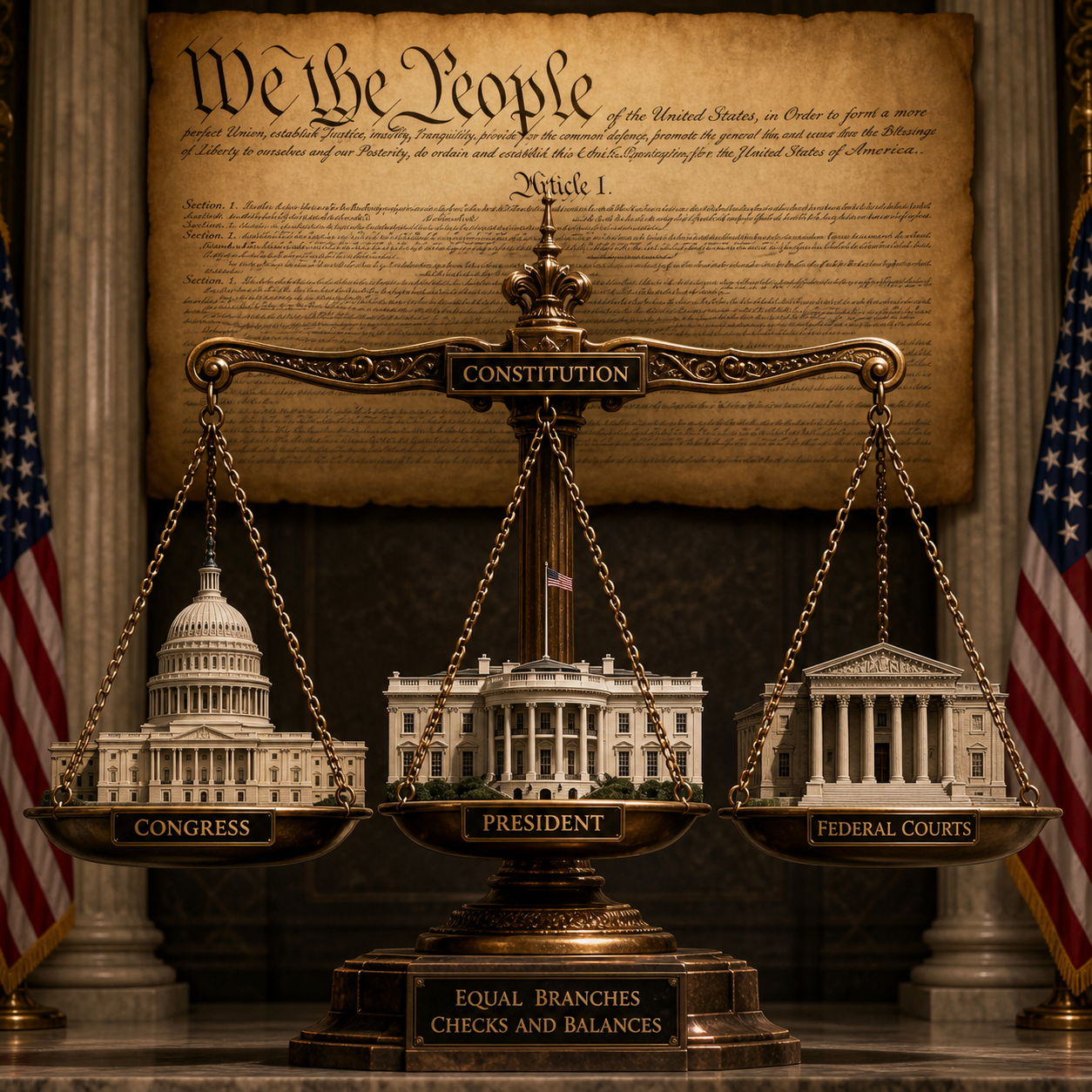
The U.S. Constitution divides federal authority among three branches so that no single institution controls the entire government. This design, known as separation of powers, works together with checks and balances to require cooperation, permit oversight, and reduce the risk of concentrated power.
What Is Separation of Powers?
Separation of powers is the constitutional arrangement that assigns legislative, executive, and judicial responsibilities to different branches of the federal government. The purpose is to divide authority so government power remains limited and accountable.
Articles I, II, and III of the U.S. Constitution establish the basic framework:
- Article I gives legislative power to Congress.
- Article II gives executive power to the president.
- Article III establishes the federal judicial branch.
This division reflects a concern familiar to the Constitution’s framers: a government becomes dangerous when the same officials make the rules, enforce them, and decide whether they were violated. Assigning these functions to separate branches creates institutional boundaries.
Separation does not mean that each branch operates in complete isolation. The branches have distinct primary duties, but the Constitution also gives them limited roles in one another’s work. That overlap makes the system practical and prevents the division of power from becoming rigid or unworkable.
Separation of Powers vs. Checks and Balances
The main difference is that separation of powers divides governmental responsibilities, while checks and balances give each branch tools to limit the others. The two principles operate together within the constitutional system.
For example, Congress has the primary power to write federal laws. The president generally enforces those laws, but can veto legislation passed by Congress. Federal courts interpret laws and may determine whether government actions comply with the Constitution. Each branch has a main function, yet each also has ways to influence or restrain the others.
A useful way to understand the relationship is to ask two questions:
- Who has the main responsibility? This identifies separation of powers.
- Who can review, restrict, or participate in that responsibility? This identifies checks and balances.
Checks are not unlimited permission to overrule another branch. A constitutional check must rest on an assigned power, such as the presidential veto, Senate confirmation authority, congressional spending power, or judicial review. The system is therefore a structured balance rather than a contest in which every branch has equal control over every decision.
The Three Branches of Government
The three branches of government have different constitutional roles: Congress makes federal law, the president administers and enforces it, and the federal courts resolve legal disputes and interpret the Constitution.
Congress and the Legislative Branch
The legislative branch consists of Congress, which includes the House of Representatives and the Senate. Congress debates and passes legislation, raises and spends public funds, regulates areas assigned to the federal government, and conducts investigations.
Because Congress controls appropriations, it can influence how executive agencies carry out authorized programs. Congress also holds hearings, requests documents, and questions executive officials through its oversight responsibilities. These tools help lawmakers examine whether laws are being administered properly.
The President and the Executive Branch
The executive branch is led by the president. The president directs federal administration, serves as commander in chief, conducts foreign relations within constitutional limits, and carries out federal laws through executive departments and agencies.
The president also participates in lawmaking. A bill passed by Congress may be signed into law or vetoed. The president nominates many executive and judicial officials, although the Senate must provide advice and consent for appointments covered by the Constitution.
Federal Courts and the Judicial Branch
The judicial branch includes the Supreme Court and lower federal courts established by Congress. Federal courts decide cases and controversies, interpret statutes, and apply constitutional principles to government action.
Through judicial review, courts may invalidate laws or executive actions that conflict with the U.S. Constitution. Courts do not generally initiate policy programs, and their authority is exercised through actual legal disputes rather than abstract political disagreement.
Checks and Balances in Action
Checks and balances operate when one branch uses a constitutional authority to review, limit, or shape the actions of another branch. Common examples include vetoes, congressional oversight, Senate confirmation, impeachment, and judicial review.
Presidential Vetoes
When Congress passes a bill, the president may sign it or return it with objections through a veto. Congress can still enact the bill if two-thirds of both the House and Senate vote to override the veto. This arrangement gives the president a legislative check while preserving Congress’s ultimate ability to act with a sufficiently broad majority.
Congressional Oversight and Impeachment
Congress checks the executive branch through oversight. Committees can hold hearings, investigate administration decisions, examine agency records, and require testimony under lawful procedures. Congress also controls federal appropriations, giving it substantial influence over public programs.
Impeachment is a separate constitutional process for addressing serious misconduct by federal officials. The House of Representatives may approve articles of impeachment, while the Senate conducts a trial. Impeachment is not the same as a criminal conviction, and removal requires the constitutional process to be followed.
Senate Confirmation
The president nominates judges, ambassadors, and many executive officers, but the Senate’s advice and consent role limits unilateral appointment power. Senators may examine a nominee’s qualifications, question the nominee in hearings, and vote to confirm or reject the nomination.
This shared appointment process reflects a broader principle: important government authority often requires agreement between institutions with different constituencies and responsibilities.
Judicial Review
Judicial review allows federal courts to assess whether laws and executive actions comply with the Constitution. If a court determines that government action violates constitutional requirements, the action may be denied legal effect in the case before the court.
Judicial review checks both Congress and the president, but it has boundaries. Courts decide legal cases within their jurisdiction, and their rulings depend on the facts, legal arguments, and constitutional questions presented. Judicial review is powerful, yet it is not a general license for courts to manage every policy disagreement.
Shared and Overlapping Powers
Shared powers require branches to cooperate, because the Constitution often assigns related responsibilities to more than one institution. Overlap makes each branch influential while preventing any branch from acting alone in every major area.
Examples include:
- Congress passes bills, and the president signs or vetoes them.
- The president nominates officials, and the Senate confirms many of them.
- Congress creates lower federal courts and determines much of the federal judiciary’s structure.
- The president negotiates international agreements, while treaties require Senate approval.
- Congress declares war and funds military operations, while the president directs the armed forces as commander in chief.
- Federal courts interpret laws enacted by Congress and assess executive enforcement actions.
These arrangements can feel inefficient because a proposal may need to pass through several institutions. That friction is intentional. Requiring separate decision-makers to participate creates opportunities for scrutiny and correction, although it can also delay action when branches disagree.
Why These Principles Matter
Separation of powers and checks and balances matter because they support limited government, accountability, and protection against concentrated authority. They make it harder for one office or institution to control lawmaking, enforcement, and constitutional interpretation at the same time.
The system protects accountability in several ways:
- Officials must operate within powers assigned by the Constitution and federal law.
- Congress can investigate executive conduct and control appropriations.
- The president can resist legislation through the veto and lead the executive administration.
- Federal courts can provide legal remedies when government action violates constitutional rights.
- Citizens can identify which institution made, enforced, or reviewed a decision.
The framework also protects individual rights indirectly. A government that must satisfy multiple institutions has more built-in opportunities for objections, hearings, judicial challenges, and public examination. These safeguards do not prevent every abuse, but they raise the institutional cost of acting outside constitutional limits.
For students, a practical test is to trace a government action through the sequence of authority, participation, review, and remedy. First ask which branch possesses the main power. Then identify other branches involved, the constitutional check available, and the legal consequence if the action exceeds its authority.
Limits and Tensions in the System
The limits of checks and balances are that they can produce delay, disagreement, and constitutional disputes, even though those tensions help prevent rapid concentration of power. The system favors deliberation over automatic action.
Several recurring tensions deserve attention:
- Overlap can create conflict. The branches may claim different interpretations of their constitutional responsibilities.
- Checks can slow government. Confirmation, oversight, litigation, and veto overrides require time and institutional effort.
- Political accountability is divided. When responsibility is shared, branches may blame one another for inaction or unpopular results.
- Constitutional boundaries are not always precise. Federal courts may need to interpret broad terms such as executive power, due process, or legislative authority.
A common mistake is to assume that checks and balances guarantee a perfect result. They do not. A check may fail to gain enough votes, fall outside a court’s jurisdiction, or be limited by constitutional and statutory rules. The system’s value lies in creating repeated opportunities to challenge power, not in promising that every dispute will end with immediate agreement.
The three-branch structure exists because the Constitution treats unchecked authority as a continuing risk. Separation of powers assigns the work of government, while checks and balances create pressure for justification, cooperation, and correction. Together, they form a durable method for limiting federal power while allowing the government to function.
Frequently Asked Questions
What is the difference between separation of powers and checks and balances?
Separation of powers divides government responsibilities among the legislative, executive, and judicial branches. Checks and balances give those branches specific tools to limit or review one another.
How does Congress check the president?
Congress checks the president through legislation, control of appropriations, oversight investigations, Senate confirmation, impeachment powers, and the ability to override a presidential veto with the required supermajority.
How does the president check Congress?
The president checks Congress primarily through the veto, executive administration of federal laws, and participation in foreign and military affairs assigned to the executive branch. These powers remain subject to constitutional and legal limits.
How do courts check the other branches?
Federal courts check Congress and the president through judicial review. In a proper case, courts may determine that a statute or executive action conflicts with the U.S. Constitution.
Why did the Constitution divide government into three branches?
The Constitution divided government into three branches to prevent excessive concentration of power, protect liberty, and create a system in which public authority would face internal limits and oversight.