Marbury v. Madison: How the Supreme Court Established Judicial Review
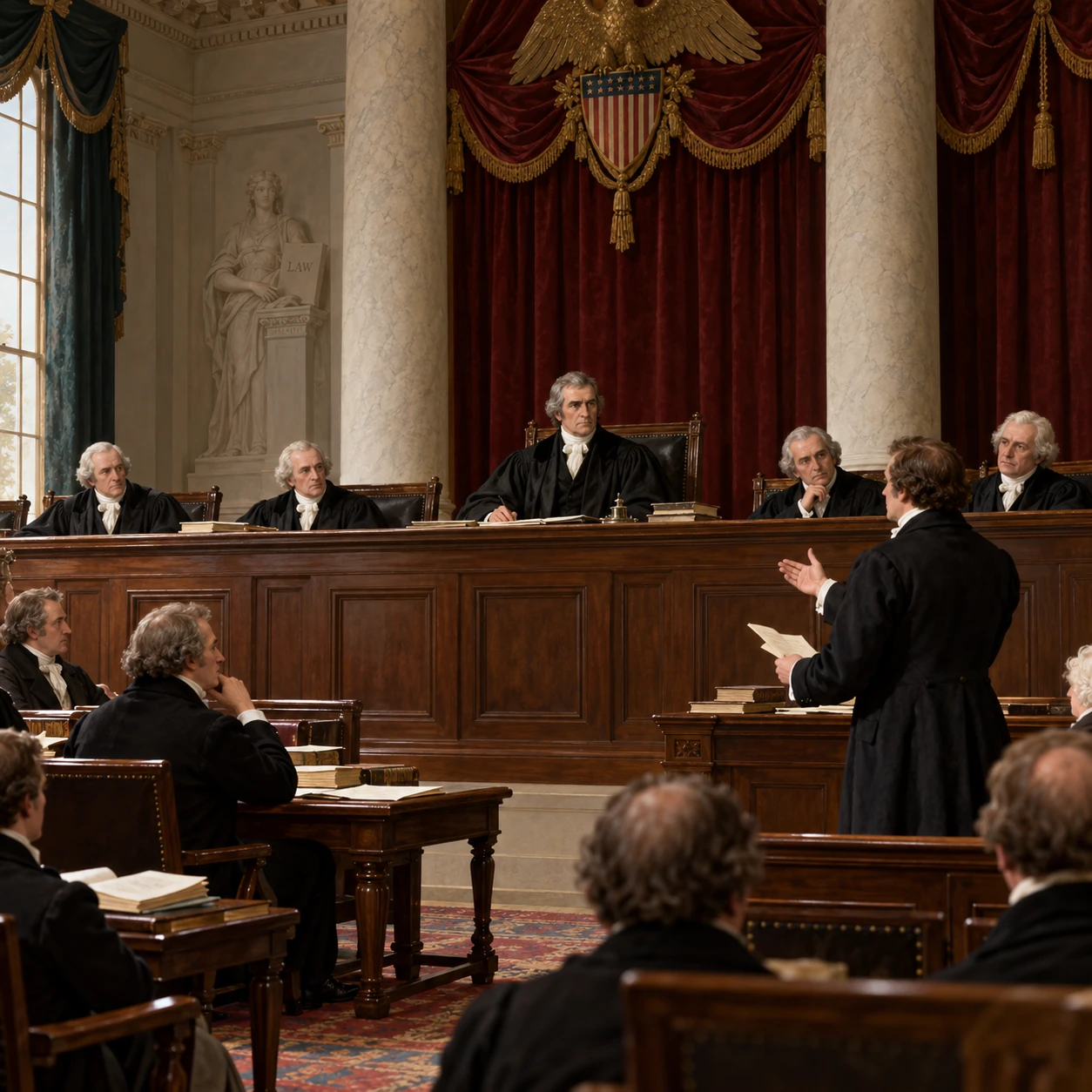
In Marbury v. Madison (1803), the U.S. Supreme Court asserted the authority to determine whether an act of Congress conflicts with the Constitution. The ruling established judicial review as a key feature of American constitutional government, even though the Constitution does not use that phrase. The case also ended with William Marbury denied the court order he sought.
The political conflict behind the case
The case grew out of a disputed transition from President John Adams to President Thomas Jefferson. Adams appointed William Marbury as a justice of the peace near the end of his term, but Marbury’s commission was not delivered before Jefferson took office.
In the final weeks of his presidency, Adams and the Federalist-controlled Congress created new judicial positions through the Judiciary Act of 1801. Adams appointed several people to these offices, and the Senate confirmed them. The signed and sealed commissions were supposed to complete the appointments. Marbury’s commission was among those left undelivered when the administration changed.
Jefferson, a Democratic-Republican, viewed the late appointments as an effort to preserve Federalist influence in the courts. He directed his secretary of state, James Madison, not to deliver the remaining commissions. Marbury therefore had an appointment approved by the Senate and signed by Adams, but no document in hand to exercise the office.
The dispute reached the Supreme Court amid a broader political struggle over the judiciary. Yet the Court’s task was narrower: it had to decide whether Marbury had a legal right, whether the law provided a remedy, and whether the Supreme Court had authority to issue that remedy.
What Marbury asked the Supreme Court to do
Marbury asked the Supreme Court to issue a writ of mandamus, an order directing a government official to perform a legal duty. He argued that Madison was required to deliver the commission and that the Court could compel him to do so.
Marbury relied on Section 13 of the Judiciary Act of 1789. That law organized the federal courts and set out some of the Supreme Court’s powers. Marbury read Section 13 as allowing the Court to issue writs of mandamus to federal officials, including when the Court acted in its original jurisdiction, meaning a case began there rather than arriving on appeal.
His petition put two issues in play. First, had Madison unlawfully withheld a commission that Marbury had a right to receive? Second, even if Marbury was entitled to it, could he bring this kind of request directly to the Supreme Court?
Those questions matter because a legal right and a court’s power to provide a remedy are separate things. Marbury could have a strong claim against Madison and still lose if the Constitution did not give the Supreme Court jurisdiction over his petition.
Marshall’s three questions and the Court’s reasoning
Chief Justice John Marshall organized the decision around three questions: Did Marbury have a right to the commission? If so, did the law provide a remedy? And could the Supreme Court grant that remedy in this case?
Marshall’s answer to the first question favored Marbury. The appointment had been approved and the commission signed and sealed, so the Court treated it as complete. Delivery was necessary to provide evidence of the appointment, Marshall reasoned, but it did not determine whether the appointment itself had taken legal effect.
On the second question, Marshall concluded that the law generally provides a remedy when a person’s legal right is violated. Madison was acting as a government official, but withholding a completed commission was not a matter of presidential discretion. The Court therefore recognized Marbury’s right to seek relief in principle.
The third question decided the case. Marshall concluded that the Supreme Court could not issue the writ because the petition did not fall within its original jurisdiction as defined by Article III. The Court could recognize Marbury’s claim without having constitutional authority to order Madison to deliver the commission.
This sequence produced an unusual outcome: Marshall criticized Madison’s refusal to deliver the commission and accepted that Marbury had a right, but the Court dismissed the petition for lack of jurisdiction. It did not award Marbury the office or the writ he requested.
Why the Court found part of the Judiciary Act unconstitutional
The Court found Section 13 unconstitutional to the extent that it appeared to let the Supreme Court issue mandamus in a case outside its Article III original jurisdiction. The constitutional problem was a mismatch between Congress’s statute and the jurisdiction the Constitution grants the Court.
Article III names the cases in which the Supreme Court has original jurisdiction, including cases involving ambassadors, public ministers and consuls, and cases in which a state is a party. In other cases within the federal judicial power, the Court generally acts through appellate jurisdiction, subject to exceptions and regulations Congress makes.
Marbury’s dispute with Madison did not fit the listed categories for original jurisdiction. Marshall reasoned that Congress could not enlarge that category by ordinary legislation. If Section 13 authorized the Court to hear Marbury’s mandamus petition as an original matter, it exceeded the limits Article III placed on the Court.
The reasoning turned on constitutional supremacy: when a statute conflicts with the Constitution, the Constitution controls. Marshall treated the written Constitution as a binding rule for government, not a statement of principles that Congress could override. A court deciding a case must therefore apply the governing law, and where two rules conflict, it must follow the higher one.
How the ruling established judicial review
Judicial review is the authority of courts to assess whether government actions comply with the Constitution. In Marbury v. Madison, the Supreme Court used that principle to refuse to apply the conflicting part of a federal statute.
The Constitution does not expressly use the words “judicial review.” Marshall supported the Court’s role by reasoning from the nature of written constitutions, the limits they place on government, and the judiciary’s duty to decide cases according to law. If the Constitution is superior to ordinary legislation, courts cannot enforce a statute that contradicts it in a case properly before them.
The decision’s method is practical: a court identifies the relevant law, compares it with the Constitution, and resolves the dispute under the controlling rule. In this case, that meant the Court could not use the Judiciary Act of 1789 to exercise jurisdiction that Article III did not provide.
Judicial review also applies beyond federal statutes. Courts may evaluate actions by federal and state governments under the Constitution, although the precise legal questions and procedures vary. The power operates through actual cases and controversies; it does not give the Supreme Court a general mandate to review every government decision whenever it chooses.
The decision’s significance and limits
Marbury v. Madison made judicial review a central part of checks and balances by confirming that courts can refuse to enforce laws that violate the Constitution. Its importance lies in that constitutional principle, not in a victory for Marbury, who received no commission through the case.
The ruling strengthened the judiciary’s role in interpreting the Constitution, but it did not establish unlimited judicial power. Courts need a case within their jurisdiction, and constitutional disputes may raise questions about standing, procedure, remedies, and the proper scope of judicial authority. Article III itself remains a limit, as Marshall’s ruling demonstrated.
The case also did not settle every debate about how the branches should interpret the Constitution. Presidents and members of Congress take constitutional responsibilities seriously in their own work. Judicial review gives courts authority to decide constitutional issues in cases before them, while political branches continue to interpret and apply the Constitution in carrying out their duties.
For students of the Constitution, the case is best understood through a three-part distinction: right, remedy, jurisdiction. Marbury had a legal right; the law generally recognized a remedy for a violation; but the Supreme Court lacked jurisdiction to provide that remedy in this original proceeding. That distinction explains both the case’s outcome and its lasting influence.